
Complete guide to filing effective police reports with required documentation and templates for crypto theft cases
A properly filed police report creates the foundation for all legal recovery efforts in cryptocurrency theft cases. The report generates a case number that exchanges require before freezing accounts, establishes an official record for insurance claims, and initiates the law enforcement process that can lead to asset seizure and criminal prosecution.
Most crypto theft victims file incomplete reports that languish unprocessed for months because officers lack the information needed to take action. Success requires preparing specific documentation that eliminates confusion and enables immediate investigation.
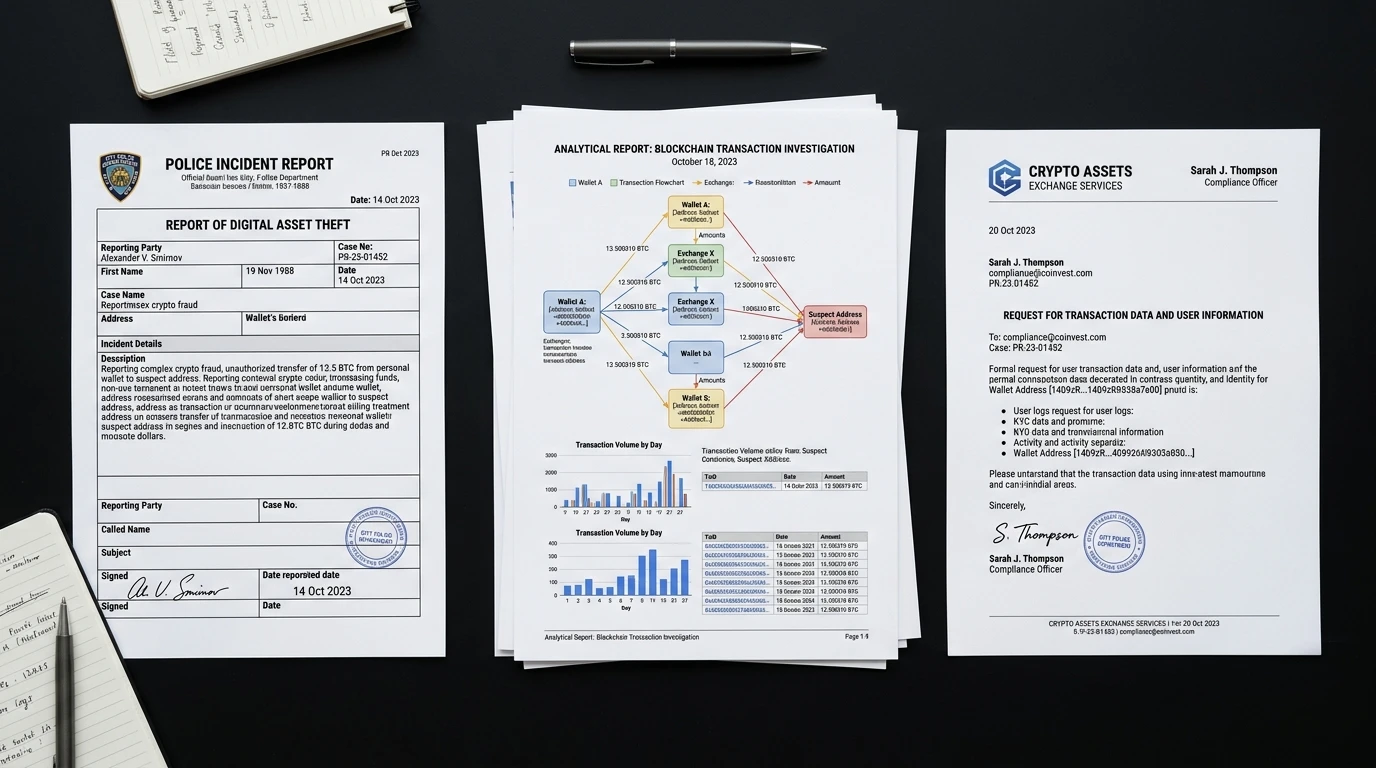
Walking into a police station with just a verbal complaint about stolen crypto rarely produces results. Officers need concrete evidence they can verify and act upon. Prepare three critical documents before filing to maximize effectiveness.
Police statement template: A clear written statement explaining what happened, when it occurred, how much was stolen, and what evidence supports your claim. The statement should identify specific wallet addresses (yours and the attacker's), transaction hashes with timestamps and amounts, the method used to execute the theft (phishing, hack, scam), and any identifying information about the attacker such as email addresses, Telegram usernames, or website URLs.
Vague descriptions help no one. "Someone stole my crypto" gives investigators nothing actionable. "On January 15, 2025 at 14:32 UTC, 5.8 BTC was transferred from my wallet address 1A2b3C... to attacker wallet 4D5e6F... via transaction hash abc123..." provides specific facts officers can verify on public blockchains.
Blockchain analysis report: Professional investigation documenting the complete path of stolen funds from theft to current location. This report translates complex blockchain data into evidence packages that officers without crypto expertise can understand and act upon. The analysis identifies where funds currently sit and whether they're accessible for freezing or seizure. Learn more about what incident analysis reports contain and how they accelerate investigations.
Exchange freeze request letter: Pre-prepared formal request to cryptocurrency exchanges asking them to freeze identified accounts containing stolen funds. This template document requires only the case number from your police report to become a legally valid freeze request. Having this ready eliminates delays between case filing and exchange contact.
Effective statements contain specific technical and factual elements that enable investigation. Include the exact date and time of theft discovery (with timezone), complete wallet addresses for both victim and attacker, transaction hashes for all relevant transfers, stolen cryptocurrency types and exact amounts, current USD value at time of theft, and a clear chronological narrative of events leading to the theft.
For phishing or scam cases, attach all available evidence including screenshots of fraudulent websites or messages, email headers showing sender information, chat logs with scammers, any promises or representations made by attackers, and payment addresses or QR codes provided by scammers. This evidence helps investigators identify patterns linking your case to other victims or known criminal operations.
For exchange or wallet hacks, document security measures you had in place (2FA status, password strength, backup procedures), when you last successfully accessed the account, when unauthorized access occurred, and what changes attackers made (password changes, 2FA removal, new withdrawal addresses added). This information helps investigators determine whether the breach resulted from platform vulnerabilities or compromised credentials.
The police case number is the single most important outcome of filing a report. This number transforms your theft from a private complaint into an official criminal investigation. Cryptocurrency exchanges and financial institutions require case numbers before freezing accounts or providing KYC information about suspects.
Without a case number, your freeze requests carry no legal weight. Exchanges can ignore them entirely without consequence. With a valid case number, platforms have legal obligations to cooperate with law enforcement. The case number also enables police to issue formal requests to exchanges for account holder information — data exchanges never provide to private individuals regardless of evidence quality.
Request the case number immediately upon filing. Some departments provide it instantly, others require 24-48 hours for processing. Either way, getting this number is urgent because every hour of delay increases the probability that attackers withdraw funds before freezes can activate. Understanding how exchange freeze requests work shows why timing matters.
Many victims inadvertently sabotage their own cases through preventable errors. Avoid reporting to the wrong jurisdiction — file where you reside, not where the exchange is located or where you think the attacker might be. Cross-jurisdictional cases create bureaucratic delays that can take months to resolve.
Don't file incomplete reports planning to "add details later." Officers process hundreds of reports weekly. Incomplete filings get deprioritized and often never get revisited. Provide all evidence upfront in organized format so the case can move forward immediately.
Never exaggerate amounts or fabricate details thinking it will increase priority. If investigators discover inconsistencies, your entire case loses credibility. Stick to verifiable facts that can be confirmed on public blockchains. Honesty and precision build credibility that helps your case.
Police departments follow different procedures based on theft amount, case complexity, and departmental resources. For thefts under $10,000, many departments simply file reports for record purposes without active investigation unless they identify patterns connecting multiple victims.
For substantial thefts, departments may assign detectives who will contact you for additional information, submit freeze requests to exchanges using your case number, coordinate with specialized cybercrime units if available, and potentially work with international authorities if attackers are located abroad. However, most local police lack blockchain investigation expertise, making your prepared documentation critical for enabling any meaningful action.
Be prepared to educate officers about cryptocurrency basics if necessary. Many departments still lack crypto theft experience, so your blockchain analysis report becomes essential for explaining what happened in terms they can understand and act upon. Review our guide on complete theft response procedures to see how police reports fit into broader recovery strategy.